The Chen Laboratory
Xiaobing Chen, PhD
Assistant Professor, Chemistry
Research Summary
Dr. Chen completed her doctoral research in physical chemistry at Louisiana State University, where she developed expertise in ultrafast vibrational spectroscopy and the molecular-level characterization of electrolyte systems. Following her Ph.D. training, she conducted postdoctoral research at University of Texas at Austin focused on applying advanced spectroscopic methods to investigate the structure, dynamics, and interactions of lipids, proteins, and water molecules in complex environments.
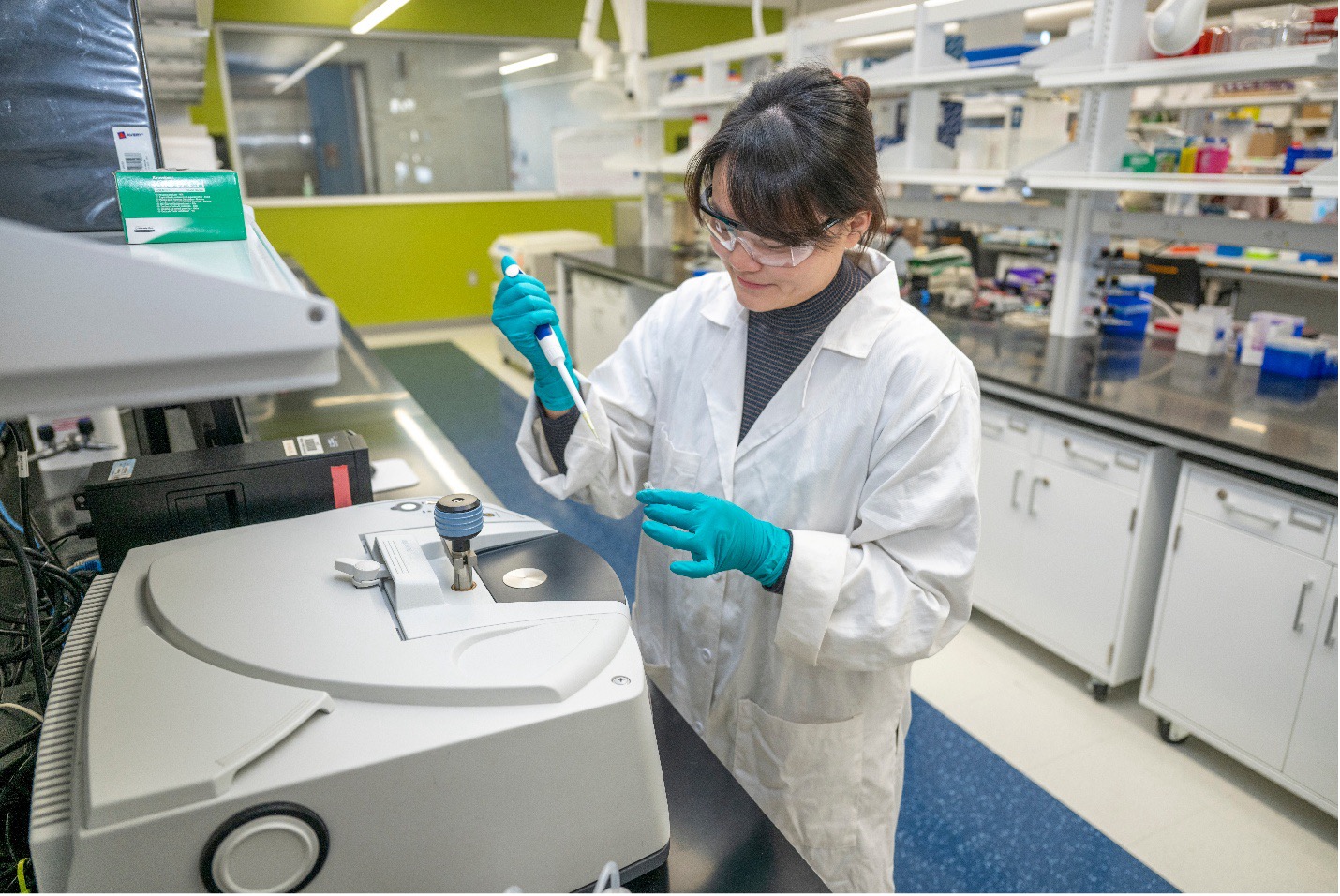
Currently, Dr. Chen is an Assistant Professor of Chemistry at Augusta University in the Department of Chemistry and Biochemistry. The Chen group integrates biophysical chemistry, spectroscopy, and molecular design to understand how lipids and proteins govern biological function at the molecular level. By combining infrared spectroscopic techniques, quantitative data analysis, and chemically engineered molecular probes, the lab seeks to uncover the fundamental principles that regulate membrane organization, protein structure, and dynamic biological processes such as cell signaling. The long-term goal of the laboratory is to develop new approaches for probing and controlling biological systems with high spatial and temporal precision, with applications ranging from fundamental biophysics to drug delivery and biomedical technologies.
Contact Us
The Chen Lab
Health Sciences Campus
Science & Mathematics Building
Department of Chemistry and Biochemistry
Research Interests
The Chen Laboratory uses vibrational spectroscopy and computational tools to investigate how molecular structure and dynamics govern biological function. Current research focuses on membrane biophysics, protein structural dynamics, and photoresponsive molecular systems.
1. Lipid Membranes and Their Roles in Cellular Function
Cell membranes are dynamic structures that regulate signaling, transport, and cellular organization. While proteins carry out many membrane functions, lipids actively influence membrane properties and protein activity. Our research investigates how lipid composition, structure, and interactions determine membrane behavior and biological function. Using infrared spectroscopic techniques and model membrane systems, we seek to uncover the molecular principles that govern membrane organization and dynamics.
2. Protein Secondary Structure and Environmental Responses
Protein function is closely linked to structure, which can be altered by changes in temperature, pH, hydration, and other environmental factors. The Chen Lab uses vibrational spectroscopy to examine how proteins respond to these perturbations and how structural changes influence function, such as protein amyloid or plagues that cause neurodegenerative diseases. Our goal is to better understand the molecular mechanisms that regulate protein stability, folding, and dynamics in complex biological environments.
3. Photoswitchable Lipids for Controlled Drug Delivery and Membrane Engineering
Photoswitchable lipids enable light-controlled changes in membrane properties, providing a powerful approach for regulating biological systems with high spatial and temporal precision. We develop and characterize photoresponsive lipid systems to investigate how light-induced molecular changes influence membrane structure, permeability, and cargo release, including photoactivated drug delivery from azo-PC nanocarriers. This work seeks to establish new strategies for controllable drug delivery and the regulation of membrane-associated biomaterials such as mechanosensitive channels.
Selected Publications
- Chen, X., Maia, R.N.A., Mulry, E., Eddy, M.T., Baiz, C.R., Solvent Reorganization in Stabilized Protein–Polymer Conjugates Visualized by Two-Dimensional Infrared and Nuclear Magnetic Resonance Spectroscopy. JACS Au 2026 6 (3), 1801-1811
- Chen, X., Li, B., Volek, T.S., Kang, J., Truskett, T.M., Milliron, D.J., Baiz, C.R., Roberts, S.T., Tracking Photothermal Heat Generation in ITO Nanocrystals and its Dissipation to their Surrounding Environment. Nano Letters 2025, 25(31), 11912-11920.
- Chen, X., Cardenas, A.E., Elber, R., Senning, E.N., Baiz, C.R., Cooperativity of PIP2 and PS Lipids Modulates PH Domain Binding. Biophysical Journal 2025, 124, 1146-1157.
- Chen, X., Al-Mualem, Z.A., Shafieenezhad, A., Senning, E.N., Baiz, C.R., Binding-induced lipid domains: Peptide-membrane interactions with PIP2 and PS. Biophysical Journal 2023, 123, 1-11.
- Chen, X., Roeters, S.J., Cavanna, F., Alvarado, J., Baiz, C.R., Crowding alters F-actin secondary structure and hydration. Communications Biology 2023, 6(1), 900.