Jessica Filosa, PhD
Professor

Phone: (706) 721-8901
Fax: (706) 721-7299
Email: jfilosa@augusta.edu
Office: CA-2092
Lab: CA-2091
Learn more about Dr. Filosa's Research
Academic Appointments
2004-2007 - Research Assistant Professor, Department of Psychiatry, University of Cincinnati
2007-2008 - Assistant Professor, Department of Psychiatry, University of Cincinnati
2008-2014 - Assistant Professor, Department of Physiology and School of Graduate Studies, Medical College of Georgia
2014-2019 - Associate Professor, Department of Physiology, Medical College of Georgia, Augusta University
2019 - Professor, Department of Physiology, Medical College of Georgia, Augusta University
Research Interests
My major research interest is to gain understanding of the signaling mechanisms governing bi-directional communication
among the various cell types within the brain. In particularly, I am interested in
the communication between neurons and
their surrounding glial and vascular cells. Recent findings have demonstrated an
important role for astrocytes as intercellular bridges between the state of neuronal
activity and vascular dynamics (or neurovascular coupling). These findings have led to a number of different hypotheses addressing the potential
role astrocytes have in neurovascular coupling. However, major gaps in our knowledge
are still present in regards to: the nature of the signals released (both by neurons and astrocytes during the hyperemic response),the mechanisms by which astrocytes decode various degrees of neuronal activities, and the targets (ion channels and receptors) involved. Until recently, the small size and location
of parenchymal arterioles precluded us from studying the intrinsic mechanisms governing
the dynamics of these microvessels. Today’s technology allows us to explore the cellular
signals controlling parenchymal microvessels in the brain. I believe this is an important area of research that merges our basic understanding
of neuroscience with that of cardiovascular physiology. Furthermore, I believe understanding the communication between these two major systems
will increase awareness on pathologies known to show vascular and neuronal deteriorations,
including hypertension, diabetes, Alzheimer’s disease and stroke.
Major focus interest in our laboratory include:
- To characterize the intrinsic properties of parenchymal arterioles in the brain.
- To characterize neuron-glial-vascular communication in different specialized brain regions
- To determine the role changes in the mechanisms underlying the crosstalk between neuron glial-vascular communications plays in the patho-physiology of cerebrovascular disorders such as hypertension and stroke.
Current Projects
- To characterize the intrinsic properties of parenchymal arterioles in the brain. The neurovascular control of the cerebral microcirculation varies depending on the location and caliber of the vessels. One of our major goals is to characterize the intrinsic properties of parenchymal microvessels from different brain areas, the types of ion channels that control their resting membrane potential and their intrinsic intracellular Ca2+ signaling mechanisms . These studies are conducted using a variety of techniques including electrophysiological recordings from isolated vascular smooth muscle cells from different arterioles (size and location) as well as intracellular Ca2+ signaling and regulation using high speed confocal Ca2+ imaging in the brain slice preparation.
- To characterize neuron-glial-vascular communication in different specialized brain regions. Most of the studies conducted on functional hyperemia have focused primarily on the cerebral cortex. However, mechanisms underlying neurovascular coupling are most likely dependent not only on the types of signals (neurotransmitters & neuromodulators) available in a specific brain area, but also on the neuronal circuits projecting to that area as well. We are currently studying neuro-glia-vascular communication in three main brain areas including: the somatosensory cortex , the supraoptic nucleus and the hypothalamus . We use a combination of state-of-the-art techniques that allows us to define the functional and anatomical changes observed in neurons, glia and vascular cells in response to a given stimulus. To this end, we are currently looking at the electrophysiological activity of different neuronal populations, their impact on astrocytic activity and the overall vascular dynamic changes resulting from these events. Electrophysiological studies are also combined with Ca2+ imaging to further understand the mode of communication from one cell type to the other, and to determine if the degree of synaptic activity is decoded by astrocytes which signal parenchymal arterioles to either dilate or constrict.
- To determine the role changes in the mechanisms underlying the crosstalk between neuron glial-vascular communications plays in the patho-physiology of cerebrovascular disorders such as hypertension and stroke. Abnormalities in vascular and/or astrocytic function highly compromise neuronal function. This project focuses on disturbances in the mechanisms bridging neuro-glia-vascular communication and their contribution to cerebrovascular abnormalities observed during hypertension. These studies will shed light on the mechanisms underlying chronic hypertension and how these changes increase the vulnerability to stroke. These studies involved electrophysiology, Ca2+ imaging and immunohistochemistry techniques in a hypertensive model (Goldblatt model of renovascular hypertension). These techniques allow us to address both functional and anatomical alterations in neuro-glia-vascular communication during the different stages of hypertension. We are also interested in characterizing the anatomical alterations of the neurovascular unit throughout the onset and maintenance of hypertension to determine if these pathologies results in the disruption of the intercellular communication between active neurons and its surrounding microcirculation.
Representative Publications
|
Yi CX, Gericke M, Krüger M, Alkemade A, Kabra DG, Hanske S, Filosa JA, Pfluger P, Bingham N, Woods SC, Herman J, Kalsbeek A, Baumann M, Lang R, Stern JE, Bechmann I, Tschöp, MH. High calorie diet triggers hypothalamic angiopathy. Molecular Metabolism 2012 (In Press). |
|
Kim KJ, and Filosa JA. Advanced in vitro approach to study neurovascular coupling mechanisms in the brain microcirculation. Journal of Physiology 2012, 590(Pt 7):1757-70. [PMID 22310311]. |
|
Filosa JA, Yao X, Rath. TRPV4 channels and the regulation of vascular tone. Journal of Cardiovascular Pharmacology 2012 (In Press). |
|
Filosa JA, Naskar K, Perfume G, Iddings JA, Biancardi VC, Vatta MS and Stern, JE. Endothelin-mediated calcium responses in supraoptic nucleus astrocytes influence magnocellular neurosecretory firing activity. J Neuroendocrinol. 2012, 24(2):378-92. PMID 22007724. |
|
Filosa, JA. Vascular tone and neurovascular coupling: considerations toward an improved in vitro model. Front Neuroenergetics. 2010, 2. pii: 16. PMID: 20802803. |
|
Higashimori H, Blanco VM, Tuniki VR, Falck JR, Filosa JA. Role of epoxyeicosatrienoic acids as autocrine metabolites in glutamate-mediated K+ signaling in perivascular astrocytes. Am J of Physiol Cell. 2010, 299 (5):C1068-78. PMID 20844244. |
|
Blanco, VM, Stern JE and Filosa JA. Tone-dependent vascular responses to astrocyte-derived signals. AJP-Heart and Circulatory Physiology 2008,294 (6):H2855-63. |
|
Sonner PM, Filosa JA and Stern JE. Diminished A-type potassium current and altered firing in renovascular hypertensive rats. J Physiol. 2008, 586.6 1605-1622. |
|
Filosa JA, Bosc-Gonzalez LV, Nelson MT. Activity-dependent NFATc3 nuclear accumulation in pericytes from cortical parenchymal microvessels. American Journal of Physiology - Cell Physiology 2007, 293(6) C1797-C1805. |
|
Filosa JA. & Blanco VM. Neurovascular coupling in the brain. Experimental Physiology 2007, 92.4, 641-646. |
Related Links

LAB PERSONNEL
Perenkita Mendiola, PhD
Postdoctoral Fellow
Adriana Langer Gramer
Research Assistant
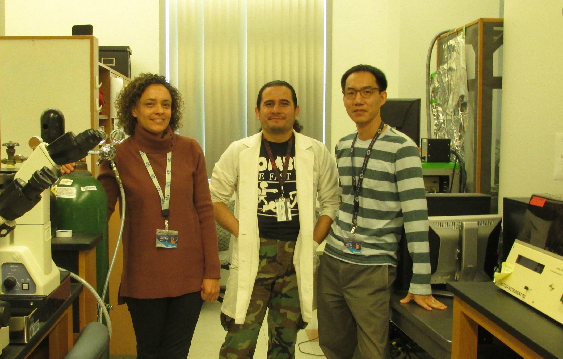 Pictured from left to right: Drs. Jessica Filosa, Juan Ramiro Diaz, Ki Jung Kim (2016)
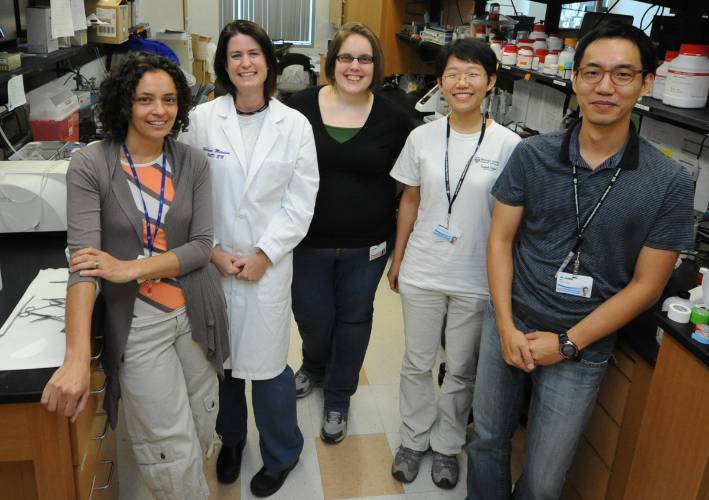 Dr. Filosa's Lab (2013)