Cleft Lip/Palate
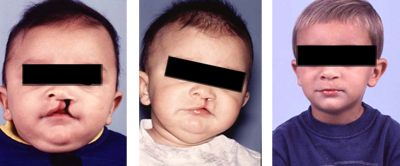 |
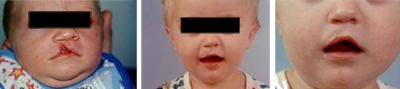 |
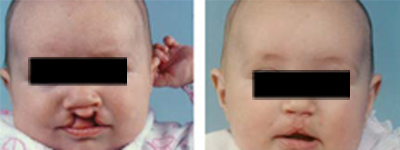 |
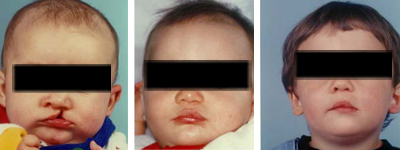 |
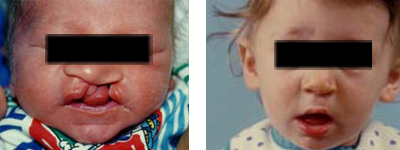 |
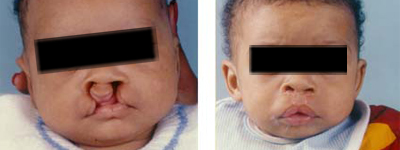 |
Family Information
Congratulations on your new baby! Although it may seem difficult at first, your baby
will probably be no harder to feed or care for than any other. Children with cleft
palates present a few challenges off the bat, of course; you will occasionally see
milk or fluids coming out of the baby's nose. The palate usually divides the nasal
cavity from the oral cavity, so a cleft in the divider lets fluids right through.
Most babies quickly learn to create a good seal to be able to suck from a bottle or
breast. With a cleft lip or palate, babies may have more trouble creating a good seal,
and might need a larger hole in the nipple or help breastfeeding with steady compression
on the breast from their mothers. It is difficult at times to breastfeed at all. The
main concern for all involved is that the baby should be able to feed well enough
to gain weight as expected.
If your baby is having a hard time getting formula through a regular nipple, we would first suggest getting the soft nipples designed from premature babies (Ross(R) makes one). You can turn the nipple inside out and cut an X over the opening to enlarge it, if necessary. When the nipple is turned right side out again, this usually makes it easier for liquids to pass through while still providing the baby with some exercise for the oral muscles. You can also cut an additional smaller cross-cut off to one side if the baby still seems to be having difficulty. Mead Johnson(R) makes a special cleft palate squeeze bottle and nipple with which we have had good success. It can be ordered through your local pharmacy.
Most cleft palate specialists agree that it is very important that children learn to swallow and breathe at their own pace, and that the normal sucking reflex leads to development of the oral musculature. This is especially important to keep in mind if a child has any other abnormalities that make it hard to feed him. Some babies require tracheostomies or naso-gastric tubes that present additional challenges to a normal feeding experience. If your child is not being fed by bottle or breast and must use a gastrostomy or naso-gastric tube feeding, it is important to associate the good sensations of getting full with sucking and swallowing (some children gradually forget how to swallow.) In that case, sham feedings are recommended, when the baby is given a pacifier if he can tolerate it during feedings to make those associations.
If your baby has a cleft palate, the muscle in the back of the throat which helps vent the Eustachian tubes in the middle ear is usually incomplete. This means that fluid will build up in the middle ears, making infections more likely. Most children with cleft palates will need tubes in the ears to solve this problem. Repeated ear infections can cause hearing loss, so we often take the opportunity when a child is scheduled for surgery to ask the Ear, Nose and Throat specialists to examine a child's ears under anesthesia and place tubes if necessary.
GHS Medical Center's Craniofacial Center has a special Cleft Clinic which meets monthly. Specialists from different disciplines--Plastic Surgery, Neonatology/Pediatrics, Genetics, Speech Pathology, Orthodontics, Pediatric Dentistry, Child Psychiatry, and Pediatric Otolaryngology (ENT)--meet together to examine and make recommendations for children seen that month. In this way, we hope to consolidate services as well as provide optimum patient care.
Cleft Lip and Palate Surgery
2-5 months - Lip adhesion
This surgery is performed only if the cleft is very wide, and is designed to bring
the anatomic elements of the lip into closer proximity to give a better result with
less tension for the definitive lip repair. ENT may perform an exam under anesthesia
and place tubes at this, or any other procedure listed, if it is necessary.
3-7 months - Lip repair
This is the first surgery for most cleft babies, and aligns the segments of the lip
both functionally and cosmetically. Nasal asymmetry is also addressed in this surgery,
and the nostril on the cleft side will be brought into a more normal position using
sutures at this surgery.
6-14 months - Palate repair
Both the hard and soft palates are repaired at this surgery. It is very important
to have the palate closed before a child reaches the age of 18 months, because it
is during this time that speech is developed. Without a complete palate to close off
the nose from the mouth during speech, children will use other techniques to try to
make sounds, and will not be able to make them properly.
Other surgeries may be necessary as the child grows, and we follow children carefully through the Cleft Clinic to ascertain when surgery, speech therapy, orthodontics, dentistry, or other interventions are indicated. Please contact us if you have questions or would like to set up an appointment at the Plastic Surgery Clinic, (706) 721-2198.
A good resource for families with cleft children is a national support group called Wide Smiles.