Back to Top
Apply Giving myAugusta
Resources for:
Students
Students Faculty & Staff Parents & Family Alumni Community
Augusta University Logo
  • Academics
    Graduates pose together in their regalia.
    Augusta University celebrates fall 2025 graduates »

    Academics Home

    Colleges & Schools

    Programs of Study
    • Degrees & Programs
    • Course Catalog
    • Course Schedule
    • Program Pathways
    • Academic Calendar
    • Online Programs
    • Accelerated Degree Programs
    Resources
    • Academic Success Center
    • Advising
    • Counseling Services
    • Honors Program
    • Libraries
    • Testing & Disability Services
    • Writing Center
    Outside the Classroom
    • Army ROTC
    • Study Abroad
    • Experiential Learning
    • First Year Experience
    • Center for Undergraduate Research
    • Career Services
    • Jags Live Well
  • Admissions
    Augusta University's jaguar mascot, Augustus, and two students hold their hands like a paw
    Augusta University awarded $1.3 million grant to expand student support »

    Admissions Home

    Visit Campus

    Request Information

    Apply to AU
    • First-Year Freshmen
    • Transfer Students
    • Dual Enrollment
    • Graduate Students
    • Medical College of Georgia
    • Dental College of Georgia
    Opportunities
    • Degree & Programs
    • Honors Program
    • Program Pathways
    • Military-Affiliated Students
    • New Student & Family Transistions
    • On-Campus Housing
    Financial Aid
    • Student Financial Aid
    • Net Price Calculator
    • Scholarships
    • Cost of Attendance
    • Apply for Federal Aid
  • Campus Life
    President Keen and First Lady stand with students to cut ribbon on outdoor rec center
    Center for Outdoor Recreation and Education celebrates grand opening »

    Campus Life Home

    Athletics

    Community
    • Army ROTC
    • Living-Learning Communities
    • Military & Veteran Services
    • Mentorship
    • New Student & Family Transistions
    • Jags 4 Jags Mentoring Program
    Campus Services
    • Dining Services
    • Roarstore
    • Housing
    • Student Health
    • Parking & Transportation
    • Jagcard
    Get Involved
    • Clubs & Organizations
    • Greek Life
    • Campus Recreation
    • Student Government
    • Jaguar Production Crew
    • Intramural Sports
  • Research
    Three men in suits stand in front of a Augusta University Medical College of Georgia backdrop and smile at the camera. The man in the middle is holding a plaque.
    MCG scientists investigate arthritis drug’s impact on Alzheimer’s disease »

    Research Home

    Opportunities
    • Undergraduate Research
    • Graduate & Postdoctoral Research
    • Clinical Trials
    • Core Laboratories
    • Innovation Commercialization
    Initiatives
    • Cancer
    • Cardiovascular
    • Immunology
    • Neuroscience
    • Aging
    Resources
    • Centers & Institutes
    • Ethics & Compliance
    • Institutional Review Board
    • Sponsored Programs
    • Tools for Researchers
  • About AU
    Five women and two men jump and raise their hands in celebration.
    AU contributed over $1.6 billion to Georgia’s economy in FY 2024 »

    About AU

    Jagwire News

    Leadership
    • President
    • Provost
    • Administration
    • Enrollment Student Affairs
    • Faculty Senate
    We are AU!
    • Our Mission
    • Working at AU
    • Traditions
    • History
    • Augusta, GA
    Resources
    • MyAugusta
    • Calendar of Events
    • Brand Guidelines
    • Portals
    • Faculty Directory
Resources For
  • Current Students
  • Faculty & Staff
  • Parents & Family
  • Alumni & Friends
Apply
Giving
MyAugusta
Trending Search Terms
  • D2L LMS
  • Email
  • Pounce
  • Calendar
  • Registrar
  • Housing
  • Academic Calendar
  • Financial Aid
  • Parking
  • Library
  • Human Resources
  • Information Technology
Biomedical Sciences
  • Admissions
    • Admission Criteria
    • Application Process
    • International Applicants
    • Tuition & Fees
    • Newly Accepted Students
  • Students
    • First Year Experience
    • Curriculum
    • Graduate Student Life
  • Programs
    • Biochemistry & Cancer Biology
    • Cellular Biology & Anatomy
    • Genomic Medicine
    • Molecular Oncology & Immunology
    • Oral Biology & Maxillofacial Pathology
    • Neuroscience
    • Pharmacology
    • Physiology
    • Vascular Biology
  • Opportunities
    • Assistantship
    • Support for Travel
    • Graduate Research Day
    • 3 Minute Thesis
    • Student Organizations
      • Biomedical Student Association
      • Graduate SGA
  • Resources
    • Templates, Forms & Policies
    • Student Services and Support
    • Dissertation Defense
  • Undergraduate Research
  • Augusta University
  • The Graduate School
  • Biomedical Sciences
  • Student Ambassadors

Student Ambassadors

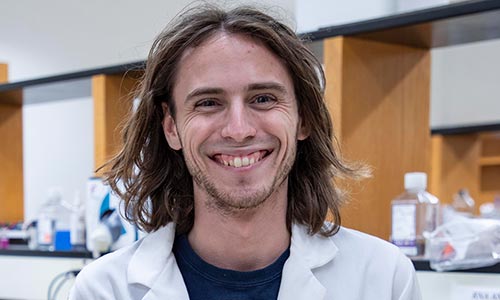
Noah Watson

Noah James Watson

PhD Program: Pharmacology
Hometown: Blount Springs, Alabama
Mentor: Dr. Sangeetha Sukumari-Ramesh
Area of Research: Epigenetics and Intracerebral Hemorrhage

Why is your research important?
Intracerebral hemorrhage is an often fatal, always devastating disease in which blood vessels in the brain rupture, causing neurotoxic blood components to cause widespread damage to surrounding brain tissue. It currently has no effective treatment, and incidence is expected to greatly increase as the overall global population ages. By targeting the brain’s inflammatory response via epigenetic modulation, we hope to develop the first effective treatment for intracerebral hemorrhage and ease the large burden the disease takes on its victims.

Why did you choose your degree program?
My original career interest was in clinical neurology, but after working for a neurologist for six months while in college I quickly realized that many, many neurological conditions have no effective, reliable treatment and that treatment is often limited to palliative care. Pursuing a PhD in Pharmacology allows me to do the most good for the most people by helping develop new, novel therapies that may improve clinical treatment options for suffering patients.

What is the greatest lesson you have learned from your mentor?
Science is difficult, and things will rarely go exactly according to plan. If an experiment doesn’t work out how you plan, don’t think of it as a failure, think of it as an opportunity to learn. Besides, there are a lot of interesting results in “failure.”

What have you found most beneficial about your program?
Augusta University is a very collaborative environment, and knowing that I can easily ask any professor or fellow student a question and get a positive response. Additionally, my work gives me the opportunity to feel like I can make a real positive change in the world.

What words of advice do you have for someone considering this program?
If you find yourself interested in a specific department or specific faculty member, don’t be afraid to send them an email! Scientists are universally nerds (myself included) who would love nothing more than telling an interested potential student about their work.

Have you been involved in any AU clubs or groups?
I serve on the Graduate Student Council and regularly attend the Graduate School Book Club, which amazingly still allows me to recommend novels to read. Both have given me the opportunity to meet people from outside the Biomedical Sciences program, which is always nice.

What have been some of your most rewarding moments as a student?
Recently demonstrating that our drug of choice has a profound impact in reducing levels of neuroinflammation after an intracerebral hemorrhage in mice was very uplifting and encouraging.

What are your career goals?
In the short term, I would like to land a prestigious postdoctoral position and do high-impact, high-quality research in the field of neurodegeneration and/or neurological disorders for a decade or so. In the long term, I think I would enjoy a teaching position in which I could help train and mentor young and upcoming scientists. In the very long term, I would like to retire and take up a position in my twilight years as a ranger in the National Park Service.

What courses in your program stand out as most helpful for your specific career goals?
Neuropharmacology has been very helpful in illustrating how different chemical compounds affect brain chemistry and communication and highlighting the exact mechanisms of the compound’s effects.

What AU resources have been most helpful?
The primary faculty and research faculty. They are all willing to help anytime I have a question or need a clarification, with a special shout out to the Department of Pharmacology’s excellent administrative staff. The vending machine near my lab which sells cherry coke is also very nice.

What do you do for fun?
I have far too many hobbies, including guitar, miniature painting, cooking, reading, hiking, and a weekly board game/Dungeons and Dragons night with other close friends in the program. I am very into music, and at the time of writing recently finished listening through the book 1001 Albums to Hear Before You Die, and am about 100 albums into my next project, listening to the top album in every subgenre listed on RateYourMusic.com, a little over 2000 total.

Former Students

"Everyone will tell you that picking your mentor is the most important decision you will make. I want to expand and add that it is equally important to pick a supportive department. An extended support network can be a huge boost to your resilience and success."

Khadijah Alexander  

"My area of research is elucidating the underlying mechanism of the signaling pathway involved in the cell proliferation and invasiveness of prostate cancer"

Mostafa Khater  

University Shield

Augusta University

1120 15th Street, Augusta, GA 30912

  •   Campus Maps
  •   Campus Contacts
  • A-Z Directory
  • Degrees & Programs
  • Employment
  • Accessibility
  • Accreditation
  • Campus Safety
  • Compliance Hotline
  • Human Trafficking Notice
  • Privacy Notices
  • Title IX / Sexual Misconduct
Apply Now Give Now

© 2026 Augusta University

Facebook Twitter LinkedIn Youtube Instagram
©